Wednesday, 10 December 2014

Planning - Equipment

This is the equipment will be used to help us film our Trailer to gain the best high quality shots possible-


Nikon DSLR d7- This camera will be used for capturing the footage for the trailer as its high quality and allows us to capture shots at a high standard. Due to Megan assessing this camera its allows us to compete different techniques such as focus pull shots and clear shots to appeal to our audience. The lens is good quality and allows us to zoom into a high definition picture in order to gain a high focused shot, zooming in to the clear detail and mise es scent of the shot.


Tripod- This tripod will be used to stabilize the camera and to avoid camera shake. This will ensure a high standard and focused shot that the audience can appeal too. The tripod is heavy and will prevent from tipping over in the strong winds as we will be shooting on field locations in rural and open stretches of ground where the winds will be strong and affect our equipment. The tripod will come in handy when capturing the establishing location shots of the farm location. The handle on the tripod allows us to fold it up and carry it round the location, making it easier to get to each shot as quick as possible.

Shoulder Rig-This Tripod shoulder rig will be used for capturing panning and moving shots that will be difficult to capture with the normal tripod. It allows stability and high definition in the shots making our work appeal to the audience. The rig goes on one shoulder while holding the handles to have stable movement in the shots. This rig can be used for panning and tilt shots.

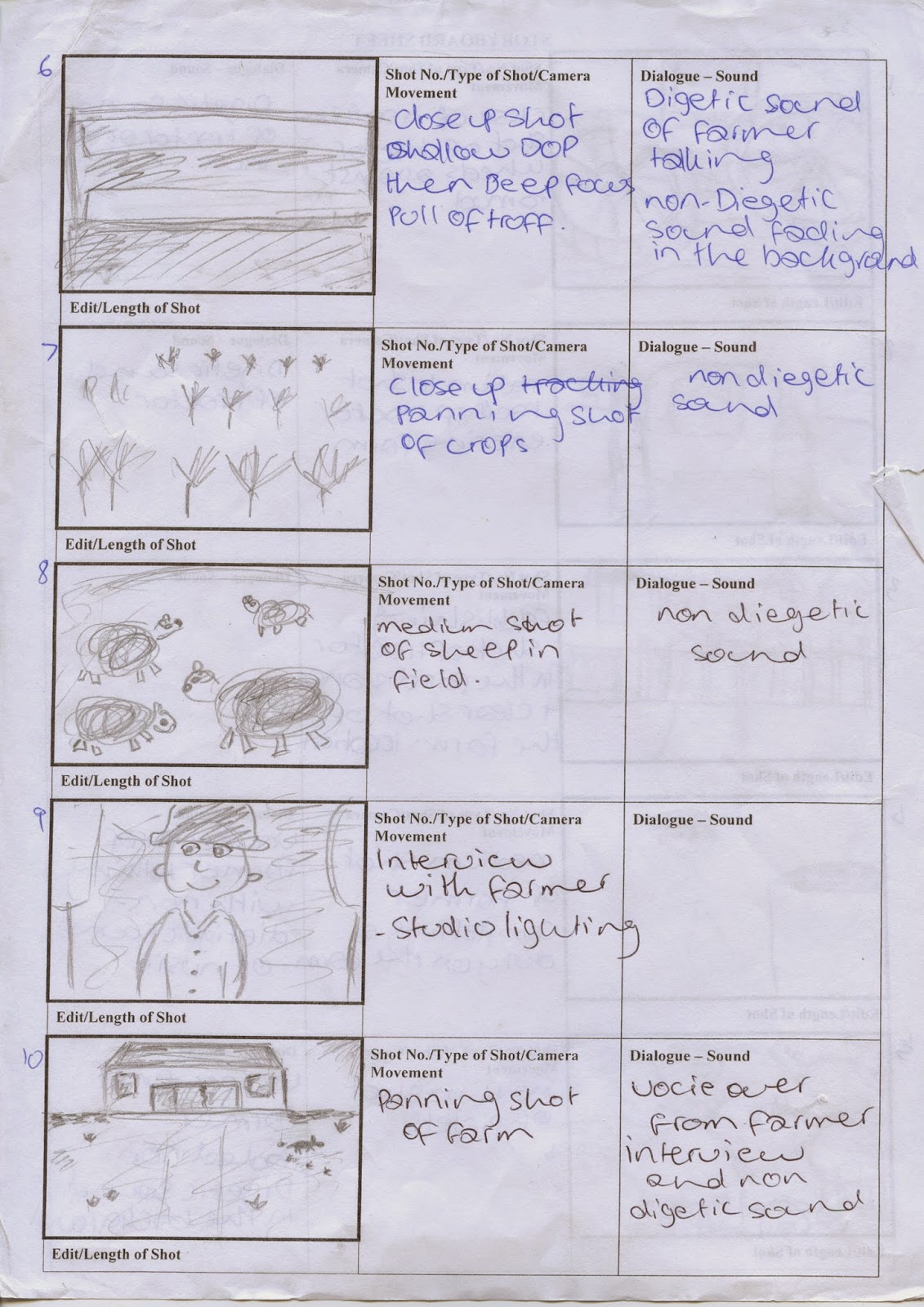
Planning - Storyboard


Sunday, 7 December 2014

Planning - Time scales

Here is a diagram of what time scales and preparation needs to be but into pre-production. for two hours of filming I worked out that there was about 10 hours of prep that needed to happen. this included items such as lighting, transport and continuity. Therefore before filming I will need to do a lot of prep work in order for my trailer to look good.

Wednesday, 5 November 2014

Planning - Scripts

As we will be doing a non formal interview with the farmer. the questions that we hope to use will be further up in my blog as we have not planned what questions we will be using, just that we want an informal interview to use as a voiceover.

Monday, 3 November 2014

Research: Diegetic and non-diegetic sound

The roles of diegetic and non-diegetic sound are very important as they both have totally different effects on the viewer and target audience. In this post I am going to be disguising the differences between both diegetic and non-diegetic and the effects they have on my viewers and target audience.

Diegetic 

Sound whose source is visible on the screen of whose source is implied to be present by the action on the film:
  • Voices of characters
  • Sounds made by objects in the story
  • Music represented as coming from instruments in the story space ( = source music)
Diegetic sound is any sound presented as originated from source within the film's world.
Diegetic sound can be either on screen or off screen depending on whatever its source is within the frame or outside the frame.
Another term for diegetic sound is actual sound.

Non-diegetic sound

Sound whose source is neither visible on the screen nor has been implied to be present in the action:
  • Narrator's commentary
  • Sound effects which is added for the dramatic effect
  • Mood music
Non-diegetic sound is represented as coming from the source outside story space.
The distinction between diegetic and non-diegetic sound depends on our understanding of the conventions of film viewing and listening. We know of that certain sounds are represented as coming from the story world, while others are represented as coming from outside the space of the story events. A play with diegetic and non-diegetic conventions can be used to create ambiguity (horror), or to surprise the audience (comedy).
Another term for non-diegetic sound is commentary sound.

Saturday, 1 November 2014

Planning - Target Audience

We want our target audience to be mainly young adults. The age gap will be between 14 and 23. This is because we want to make the younger generation aware of what effort there is to put food on the table. By following one day on one british farm we hope to make youngsters aware of what goes on behind the scenes.